* Junio \u200b\u200bValerio Borghese
"After a year of tests and experiments conducted on Lake Iseo by Sub-Lieutenant Massano, some of which I attended, had been put point to the submarine assault, CA, adapting to its new functions; while in Bordeaux, meanwhile, where the command the basis of our submarines had been hired by the Atlantic sea captain Enzo Grossi, had the opportunity to fruition, which I tried, to use a submarine to the ocean transport of CA near the enemy base. Two operations were being prepared in this way: an attack on New York, going up the Hudson with the CA to the heart of the metropolis, the psychological effect on Americans, who had not undergone any military offensive on their territory, far exceeded In our context, the material damage, which would have been imposed (and ours was, to my knowledge, the only practically feasible plan designed to bring the war in the U.S.). The other operation involved an attack on the important English stronghold of Freetown (Sierra Leone), home of the South Atlantic squadron. The undoubted difficulties of these operations had outreach were largely offset by complete surprise, the appearance of the media assault on the Italian Navy, which had until then limited their action to the Mediterranean area, was not provided for: defensive measures against this type of attack was not unexpected presumably in place. The action against New York, in an advanced state of preparation, was established for the month of December 1943. "
* Fast and invisible from , edited by Alexander the Great March, Basic Books, New
In 2007 December 1943, special units of the Tenth Flotilla MAS were ready to attack the port of New York. The plan provided for the transport of a mini-sub type of the CA to Fort Hamilton, hence the half with a crew of men on board-range would have moved up the Hudson River until it reaches the port, where the raiders divers, unleashed upon the seabed, would be hit with special explosives to the ship berths.
From a strictly military damage would be limited and minor, but in terms of psychological action would have a devastating effect. For the first time a foreign military power would have hit the United States on its national territory. An act of sabotage, an attempt that could be defined as terrorism if it was not conceived as part of a global conflict where the distinction between civilian and military targets was not just so, in none of the sides in the field.
More than fifty years away from that mission ever, and even in a context comparable to that of December 1943, the attack on the Twin Towers made by Islamic terrorists would have achieved a result similar to that which had brought the Royal Navy Italian: to bring the war on American soil, dealing a hard psychological blow to a nation far from the destruction and the bloodshed in the rest of the world.
Since the beginning of the Second World War, for strategists Axis the United States was a difficult and distant goal: the Germans were never able to wear their jerseys saboteurs than American intelligence to strike at war industries across the ocean, and after Pearl Harbor the Japanese had so sent a submarine to bomb the California coast, but the results were only negligible damage and a lot of confusion. An episode due more to curiosity and the tragic vagaries of war than to any action likely to be remembered in history books.
Attach the port of New York would instead had much more impact, even under the strategy profile. I knew the commander of X-Mas, Junio \u200b\u200bValerio Borghese, knew the leaders of the Navy, knew the men who trained for almost a year to the mission.
The attack on the port of New York, which should have followed a similar raid in the African base in Freetown, Sierra Leone, was not completed to the armistice occurred. But everything was ready for what was undoubtedly the most spectacular special missions of the media onslaught of the sea. The action was assigned to the Tenth Flotilla MAS, Department of raiders whose origins are traced to the end of the First World War. In the years following the First World War, the Navy worked to perfect the means on the basis of the treacherous success by Raffaele Rossetti and Raffaele Paolucci with the sinking of the "Viribus Unitis," especially considering how to change the 'leech', the device designed with such difficulty from Rossetti and used for sinking the Austrian battleship. At the same time were improved techniques of diving with the design and testing of new apparatus. The Ethiopian crisis favored the development of insidious means, but it was only in 1939, with the approaching war in Europe, it was decided to assign more men and resources to the sector, particularly in the Flotilla Mas.
order to better follow how the project grew directly attack the coast of the United States, we must turn strictly technical aspects of the missions of X-Mas, the specific propensity to put the talent to serve the war effort, which was certainly not exclusive to that department, but he found fertile ground in the 'substantial impermeability to external factors "characteristic of special training , and in particular the X Mas.
is in this context that faces another key player in the draft of the attack at the port of New York, Eugenio Wolk, creator of Men-gamma, the protagonists of many secret missions under the sea between 1942 and 1945 and also after the war. Wolk landed in 1941 in Livorno divers School wing, headed by Angelo Belloni (star the second chapter of this book).
techniques of underwater exploration is still in its infancy, but it's there, in secret bases of the navy, which studies the transition from old to modern diver diver. The idea dear to Belloni of marching soldiers on the sea floor was immediately recognized as the same Wolk, "unrealistic." The Marines were equipped with a waterproof suit, a closed-circuit breathing apparatus with two cylinders, shoes weighted diver with admiralty bronze bearing "teeth" to avoid slipping on the bottom, a compass, wrist watch, bags extra, compensating weight, pressure gauge depth. The intruder was carrying a bomb on his back then shaped drum weighing 50 pounds. So tanned, the Marine had to go out - at night - from a submersible resting on the sea floor, walk for two or three kilometers between current and unexpected pitfalls hidden networks and overcome barriers to protect ports, to reach the ships at anchor , place the bombs and come back. An obvious folly.
So the attack as it was designed could not work. The image of "Twenty Thousand Leagues Under the Sea" of armed men walking on the bottom very easily could have led to desired results. We had to change tactics, or rather we must change our way of conceiving the underwater incursion of troops seen as approaching the target. Wolk spoke with Borghese, and the solution found was the most obvious: people should not walk on water, but swim. The raiders were not supposed to look like medieval warriors, but rather had to be confused with fish, and how they move. So off heavy boots, via the ballast and waterproof overalls, by the trappings bulky. Wolk designed a pack of gum that was as strong as possible and close to your body, under which the intruder was wearing a wool suit and another suit over which light was to protect against rips and tears. But above all, Wolk invented an accessory then still unknown and who later enjoyed a global fortune fins.
Peter Spirit
* Lapo Mazza Fontana, Italy über alles - The X-Mas: for their country against all , Boroli , Milan
The book is inspired by a little-known episode of World War World: The project never happened and attack submarines and raiders of the departments of Xa MAS against the port of New York, scheduled for autumn 1943.
* 1942. Attack on New York
In June of 1942 the submarine Leonardo da Vinci had to destroy the port of New York, a military plan designed during the Second World War by the Navy. The Leonardo da Vinci however, was sunk in April in the Atlantic and the mission was postponed to October. But in September Italy signed an armistice. The novel fantastorico Marcello Tessadri [Yeast, Rome 2008] reconstructed in a breathtaking narrative for this attack that only one set of circumstances has not been implemented.
* Xa fleet's attack against New York Mas
by Cristiano D'Adamo
For most historians, the activities of Xa MAS Flotilla were confined to the Mediterranean. Indeed, in the early months of the war, the unit focused solely on British targets within the Mediterranean basin. Unfortunately, the unwise but bold attack on the island of Malta July 25, 1941 destroyed a large number of highly trained officers and NCOs as well as most of the command structure of the unit. The responsibility of continuing the activities of the Xa MAS Flotilla fell to the commander of one of its two divisions: Junio \u200b\u200bValerio Borghese. This officer, who had already distinguished for his ability to bring raiders and "pigs" in the vicinity of the enemy bases in Gibraltar and Alexandria, became the heart and soul of the Xa MAS Flotilla. After the war, Commander Borghese recounted the exploits of the Xa MAS in his well known book. After the capitulation of September 8, Commander Borghese decided to continue fighting alongside the Germans in northern Italy, by changing the Xa MAS Flotilla in training to a large extent of land and with anti-partisan. At the end of the war, when he appeared confident his imprisonment, despite the Gold Medal for Military Valor received during the conflict, Borghese decided to move to Spain in a self-imposed exile that lasted until his death. The role of the Borghese
Xa MAS Flotilla was of great importance. This man was not only a commanding officer, but also a leader. Borghese, as he later wrote, understood perfectly the value of the 'psychological effect on Americans who had not yet undergone offensive war on their own soil. " From his point of view, to conduct an attack outside the Mediterranean was of great importance. The idea was bold, but realistic. The Germans had prepared similar plans that rely on saboteurs to infiltrate the United States and then damage the industrial production, but their plan did not succeed. These attacks were made vain by American information system, which was already well developed, and the island nature of the American continent itself. After the attack on Pearl Harbor, the Japanese sent a submarine to bomb the coast of California to cause only negligible damage and a lot of confusion.
Borghese intended to bring the war to the American continent by conducting an action that has been shown, which would have a limited military value in terms of damage inflicted, but a tremendous value in terms of psychological effects. The plan, which today have only limited documentation, provision for the transportation of a weapon near insidious "Fort Hamilton, New York, and then ensure that these navigators with its own resources on the Hudson River, reaching the port of New York to install explosives in some of the ships moored along the west jetty. Due to the nature of that port, and the distance from the ocean in New York, the use of SLC (pork) was neither appropriate nor practical. In the Mediterranean, the Xa MAS Flotilla had used the carrier with submarines of three cylindrical containers mounted on the deck. Subsequently, the cylinders were installed and became four on the sides of the hull. The cylinders were used to protect the SLC from the weather, but it makes navigation more difficult and, because of their size, extending the profile of the vessel, thus increasing the risk of being located. The Xa Flotilla MAS would try a different system for the attack on New York, half prepared for longer missions that would protect his crew from the weather, small size and low profile. The solution would be found in a military warehouse in the port of La Spezia.
The medium in question, known as the CA, was the invention of the Caproni company Originally founded by John Caproni known for the construction of modern aircraft, winning many races in the world. During the crisis of 1935, when Italy was on the brink of a war with Great Britain and the Italian Navy founded what would later become the Xa MAS Flotilla, the Caproni was asked to collaborate with the Navy in the construction of a new assault weapon. This collaboration between the company and the Navy aircraft was strange, but allowed the introduction of new and unique engineering ideas in the traditional field of naval engineering. Caproni sought the assistance of a naval engineer and selected Goeta Vincent, an independent marine consultant with offices in Genoa. The project Goeta-Caproni, as will be known later, was presented to the Committee a few months after the design of Navy ships, a committee chaired by General Umberto Pugliese, an officer of great talent and well known for the invention of a system underwater protection that still bears his name. The project was submitted to the Navy in early 1936 that was approved three months later, this rapidity of approval was a great encouragement, especially considering that the ideas proposed by the firm Caproni were unusual and very innovative.
Caproni called this medium "submarine boat", but was actually a submarine. The plans of the Caproni, this little half was the equivalent of a fighter plane, the experience of the company in the aeronautical field was an important factor in designing the means and its possible use tactics. Unfortunately, the Navy was not ready to embrace these new ideas and quite original, but at the same time there was enough interest to continue with "Project G" Construction began in a shed at the factory Caproni Taliedo near Milan. This was a tiny submarine pressure hull with hemispherical caps at both ends. Ballast tanks, launchers and other components were installed outside the pressure hull. The project involved a crew of two men: the official the command would have occupied a special place from which he had access to the periscope and controls, especially at the control lever (joystick), as on an airplane and also the navigation equipment that is more like a fighter than a control room. The other man crew would be, close to the engine in the supine position because there was not enough room to stand.
The first prototypes were delivered to the Navy in 1938 in total privacy. Loaded onto special rail cars and camouflage, these strange vessels were transported to Lake Iseo, near Brescia and Bergamo. This lake of modest size reaches a maximum depth of 250 meters and ha un perimetro di 60 chilometri. Il lago ha la forma di una esse con un’isola di piccole dimensioni al centro. I primi collaudi confermarono le buone qualità dei mezzi e consentirono la correzione di alcuni difetti e il miglioramento della componentistica. Naturalmente, a causa della mancanza di salinità, la riserva di spinta era differente dal mare, così i collaudi continuarono a Venezia. All’arsenale di Venezia, cantieri navali questi con una lunga ed illustre storia, tre giovani ufficiali iniziarono le prove ufficiali. Questi erano i Tenenti di Vascello Totti, Gatti e Meneghini. Gli ulteriori collaudi confermarono la presenza di problemi già noti, in gran parte aventi a che fare con la sensibilità dei controlli. Il sommergibile era able to navigate on the surface at a speed of 7 knots submerged speed of 5 knots. In addition, two 450 mm torpedoes were fired multiple times without any problems.
completed the tests in Venice, the two submarines were sent to La Spezia, the largest Italian naval base. The experience gained during the trials of CA 1 and CA 2 led engineers to increase the displacement of 4 tons, reaching the 20 GRT Subsequently, the two prototypes were abandoned in a warehouse, the same store where they will be found by the Xa MAS Flotilla . As had been abandoned for more than two years, the two submarines were not in good condition and it was decided to send them back to the factory for overhaul and also to make some changes. Once modified, the two boats would be suitable for the Xa MAS and the two torpedoes were removed and replaced by eight explosive charges of 100 kg each. These charges would be manually placed under the keel of ships from enemy raiders. The diesel engine was removed because these vessels were to operate like a pig and, therefore, within the range of electric motors. Other changes included the removal of the conning tower and periscope. With thermal engines removed, the second crew member became the operator to explosive charges. The equipment for the raiders was the same one used by operators of the pigs, consisted of a pack of gum and a breathing apparatus with pure oxygen.
At the end of this work, the CA should be regarded as new media. The range was limited to 70 miles, but the speed was increased under water at 6 knots, while the maximum depth was tested at 47 meters, excellent performance for a boat so small!. Further testing highlighted other shortcomings, some of great importance. The explosive charges placed in the cavities left by the removal of torpedo tubes at the bottom of the hull is made that the release of the bombs was somewhat cumbersome. Consequently, the two cavities were eliminated and the explosives were placed almost at the bridge. The pump was considered Pants too noisy (this was a problem on all Italian submarines) and, therefore, was removed to be replaced with a manually operated by one of two crew members. During testing of a CA on Lake Iseo, the boat was damaged and sank a little and then be recovered, but the boat was not able to be used for a considerable period of time. Thus, the Xa MAS was not a boat ready for use: AC 2.
Anticipating the repackaging of a CA in a short period of time, Commander Borghese considered two attacks in the Atlantic: one against the British base in Freetown, and one against New York. Transported to the mini submarine on the spot, Borghese needed submersible carriers, but those assigned to the Xa MAS were too small for oceanic operations. Then, according to his memoir, Borghese tried to get loan from Kriesgmarine submarines, but it seems that Admiral Doenitz, commander of submarine forces in Germany, could not do without anybody. If a German submarine had been available, the chances of success would have been much higher because the U-boats were newer, more maneuverable and less prone to failures of the now national Vecchiotti boats.
During this period the Italian Navy was still operating in the Atlantic naval base in Bordeaux, and Italian vessels were suitable for the mission because their considerable displacement, but unfortunately there was very little availability. The base commander was Rear Admiral Polacchini Romulus, later replaced by Captain Enzo Grossi, famous for having claimed to have sunk two American battleships. Ankle, they say, put the boats to the immediate provision of Borghese, and the latest Big encouraged and gave support to the mission. The submarine was the carrier selected Leonardo Da Vinci, Marconi Class ocean a boat under the command of Lieutenant Gianfranco Bazzana Priaroggia (the boat was previously under the command of Captain Louis-Longanesi Cattani, a submariner of great talent and quality here were certainly appreciated by the Commander Borghese. According to the authors and Carisella Schofield, during sea trials Borghese himself was in command of the submarine. Although possible, this seems unrealistic because Borghese had never driven a boat of this size and complexity.
The Leonardo Da Vinci was one of the most active ships of the Italian fleet. On July 1, 1942, he returned to Bordeaux after a long mission in which they were sunk 20,000 GRT of enemy shipping. Upon arrival in Bordeaux, the boat was sent in the arsenal to be transformed into submarine carrier for the CA 2. Under the direction of Major Julius Feno, head of Naval Engineers, the bow gun was removed and its base was built a cradle between the pressure hull and deck. The mini-submarine was seated in the cradle with about one quarter of the hull below deck and the rest hanging, but without obstructing the view from the command bridge of the conning tower. Two large metal hooks shaped like a pincer would ensure the CA to the boat. Although no one knows for sure, it seems that the submarine carrier was able to deliver electricity to recharge the batteries on board the mini-submarine.
The sea trials began in September 1942. On September 9, Da Vinci went to sea with its cargo back to release test and riattracco. The very difficult and tedious operation was repeated several times until the 15th of that month when it was found that everything was in order. The Da Vinci could start within days, but it was still too early. The mission was scheduled for December, when the daylight is short and the darkness of the night give operators more time to penetrate the enemy port and place the explosives. In addition, the Xa had little information about the situation in New York and was seeking further information. For reasons that escape us, the mission was moved to December of 1943, but that never happened. Some secondary sources claim that Borghese was awaiting delivery of the CA 3 and CA 4, two mini-submarines, the newest and most advanced [for example, according to this source : "The men of the Tenth MAS rimandarono l'attacco a New York ritenendo indispensabile costruire una evoluzione del CA. 2 con caratteristiche specifiche al trasporto di commandos e cariche esplosive. Nella primavera del 1943 il progetto del nuovo minisub è terminato e presso lo stabilimento della Caproni si inizia a costruirne due esemplari, denominati CA. 3 e CA. 4. Contemporaneamente e segretamente degli uomini della Decima MAS raccolgono informazioni sui porti di New York e Freetown”]. Nel frattempo, il 6 maggio il T.V. Bazzana Priaroggia fu promosso “per servizi in guerra” al grado di Capitano di Corvetta, ma pochi giorni dopo, il 22 maggio, il Da Vinci lanciò l’ultimo messaggio radio informando la base che stava iniziando la navigazione silenziosa. Il battello Bordeaux was expected within a week, but never arrived. In 1945, the British Admiralty confirmed that on 23 May at 11:35 (GMT) the destroyer "Active" and fegata "Ness" had led an attack off Cape Finestrelle. There were no survivors and the Xa MAS Flotilla had lost the only submarine commander and the only carrier to release and trained riattracco CA.
A few months later, on September 8, 1943, Italy announced an armistice with the Allies. Most of the Navy joined with the terms of the armistice and, although officially still in place, Betasom ceased to exist. The CA was in Bordeaux under the supervision German and when the city was evacuated in 1944, this was abandoned. In 1945, AC Bordeaux 2 was found in a railway carriage set on wooden blocks and chains. The hull was nearly intact, including the propeller, but control plans had been removed. We do not know when, but the small submarine was destroyed. The other submarines of the class CA went too lost, in some circumstances still mysterious, and all that remains are a few faded photographs. After the Armistice, the Royal Navy and the U.S. Navy is very interested in the Xa MAS tactics and studied with great thoroughness. The traditions of this small group are still alive in many marine special forces.
* sea and sky ...
The unfavorable development of the conflict forced him to gradually reduce the number of missions Xa Mas fleet. Were still evaluated and planned actions in South Africa (the main hub for the Allies) and up into the Hudson River in New York, but were never realized. In particular, the action against the Port of New York was rated as an act of solo X ª MAS Flotilla, which in the context of mission support for the activities of the Royal Air Force dubbed Operation S. In this case, a tenth of the submarine should have made a supply in the Atlantic Ocean as a staging for the seaplane CANNOT Z.511. The idea was deemed too risky Royal Air Force and later opted for a non-stop mission with a four Savoia-Marchetti SM95. Although this mission was in draft form for the armistice.
S * Operation
April 1942 - September 1943
[from ' last chapter of the volume of Luigi Romersa, Hitler's Secret Weapons , reprinted in 2005 by Murcia]
The idea of \u200b\u200bthe attack from the air, the kind that carried on by Gabriele D'Annunzio Vienna towards the end of World War I, was aired by the Air Force General Attilio Biseo, holder of record, fly across the Atlantic from the South and North with Marshal Italo Balbo's aviation brigade commander and the "Lion" when he was summoned to Rome by the Chief of Staff General Ugo Cavallero, for information on the operational characteristics of MC 203 new fighter aircraft, recently selected for mass production. It was April 1942. At that meeting, held at Palazzo Vidoni, in Corso Vittorio Emanuele, also attended the engineer Armando Palanca that, at the Department of experiencing the flight Guidonia, had followed the approval tests of the beautiful fighter aircraft. A friend told me about Palanca so that secret meeting: "We of course discussed the air war both English and American enemies of heavy bombing on villages and, suddenly, General Biseo said: "Think of what would be the effect on the American people that we feel safe and far away from the conflict, launching some bombs on a village high density as Manhattan ...". The sentence thrown out, caused the consensus of those present but was not thorough. We merely to examine various aspects of the surface and above the many difficulties as it would have to take a flight of 12,000 kilometers, almost entirely controlled by the enemy in heaven ... Cavallero still interested listened, nodding his head at times and occasionally shook his head instead to highlight the difficulties and dangers who presented the attack. At one point General Biseo he came up with a joke that left all these pretty surprised. "We, too," it said, "we should do like them and attack any site that its distance from Europe is considered one hundred percent sure. Do you remember the effect that made the bombs dropped on Tokyo from an isolated American unit, took off from an aircraft carrier to Doolittle and sod? "Cavallero looked among the curious and amused. He got his glasses on his forehead and said: "No way, dear Biseo; agree to the psychological effect, but we do not have aircraft carriers ...". He paused, went back to put on his glasses and said, "But I take note. I'll talk to the next meeting of the Joint Chiefs of Staff and natural ally with the Duce. " They spent a few months and the raid on New York no longer spoke. "On November 8, 1942 - Palanca always told me -" Suddenly, the idea of \u200b\u200bre-emergence Biseo and, as an expert on trans-Atlantic flights, I was summoned to the Piaggio, Pontedera, to participate as an inspector for armaments and aircraft engine technologies for high altitude, at a meeting organized by General Fernando Silvestri and sponsored by the Air Force chief of staff, General Rino Fougier course, the also intervened as the Deputy Chief, General Ilari, Captain Publio Magini, Admiral Luigi Sansonetti and a navy captain, submariner. On that occasion it was decided the demonstration against the area south of Manhattan, using the flight is code-named "Operation S", a four-engine seaplane Cannot. Z511, designed by engineer Philip Zappata.
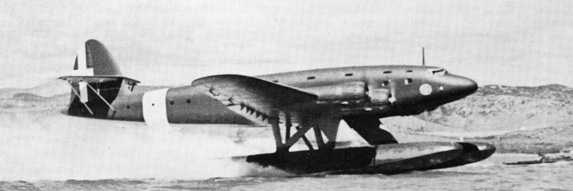
By that time, it was a giant machine, intended for civil transport, which, however, despite its con-siderable autonomy, should have made a supply in the middle of the Atlantic, here is, therefore, the reason the presence of the meeting Pontedera, an admiral and an official submariner "Under the plan, to supply the Cannot. Z-one would have to provide a submarine lurking in the ocean a point located more or less half of the route followed dall'idrovolante. The plane was leaving from a base in western France, to stop in the water, able to fill the tanks and go to New York. "All right" - says Palanca - "until the debate was at an academic level, but when the general Silvestri and Ilari, in full agreement with me, began to review the details of the mission, the result is not an easy task. The first concerned the landing and departure in the open ocean with the sea agitated, and almost always with strict adherence to the radio silence, while the other was represented by the doubts raised by the sea, on the outcome and effectiveness of the raid, following a series of tests, rather disappointing, performed with the plane 12 to 20 November 1942 seaplane Vigna di Valle. In theory, the unit must have a range of 6,000 kilometers, which would have required a single fuel but the engine which was fitted, the P. XII RC33 addition to providing for the keeping expectations low, given the length of the flight, proved true fuel guzzlers. " The setbacks, however, were not enough to persuade the military authorities to set aside the transaction. On 22 November, in fact, was selected the second rider in the person of Captain Armando SIDES of Olives, and two days later, with the participation of officers of Supermarina, was called to supply the equipment at sea and were determining the mode make the transfer of fuel from the submarine to the airplane, the easier and faster. on 23 November, after a painstaking series of tests, the General Staff ordered the Air Force Piaggio, with the highest priority, a number of engines to be installed on Cannot. Z 311 most powerful take-off and consume less than those enjoyed by the prototype of the intended long flight. At this point, for the record, it must be said that the Hydro was ordered in 1937 from the wing Littoria for links with South America and manufactured in May 1940 the shipyards of Monfalcone. At the beginning, when it was tested, the gigantic seaplane seemed more interested in the marine e-aeronautics sector, which wanted to use it for actions in the assault "Avio-Gamma", the first of which, with a jump of 4,300 kilometers, was end with the bombing of the Persian port of Banda Shapur, from where British aid for the Soviet Union. After twelve days from the demands of the aviation authorities, in record time, you should say, Piaggio sent Vigna di Valle a new kind of six thrusters, in a very short time, were mounted on the plane. However, in spite of the technical adjustments, the Navy expressed other doubts, certainly well founded, so that in one of the last meeting Page 3, the plane was finally discarded.
 dell'Idro Even the provision, however, meant the renunciation of the daring enterprise, and indeed, in its place, he was chosen a four-land, the SM93, at an advanced stage of construction, with more than 12,000 km of autonomy , therefore able to make the journey and return without refueling in between. It was the machine was needed to ensure successful implementation of Operation S. On 3 January 1943, the Air Force chief of staff, General Fougier, summoned the Deputy Chief, General Ilari, Colonel Captain Magini Porru Locci and to establish the program operations of the EMI plug. During two meetings, at a distance of just over ten days, were discussed and resolved the remaining issues presented by the difficult route. The four-occupied France but had to return from directly in Italy. In May 1943, the project was submitted for the approval of Mussolini. Il Duce wanted to know the names of the pilots, the characteristics of the machine, then, shaking his head, said: "Everything is fine, but nothing explosive. We're not going to do damage, but to demonstrate that despite the existence of the ocean to America where he feels safe, we can reach it when we want. Instead of bombs, I know, we could launch on Manhattan Sicilian oranges, hanging from parachutes tricolor. The exclusion of the bombs made it possible to further increase the load of gasoline, 23,800 liters calculated and guaranteed to cover a distance of more than 13,000 km. Everything was decided in the car and the men were ready, but when he made the last test of the engine, suddenly came the armistice.
 Postscript
transcribe, in memory of the frantic work of that time for the realization of the attack in New York, provided for the first days of September 1943, the last pages of notes written by himself by his Armando Palanca, planner of the famous "Operation D". This is a long history remained secret and that, like many others, will end up in some archive, not to be forgotten, but reminded that tomorrow is today and especially not to hurt a friend I would often say: "Remember, never shy away from their past. "
15 to 16 May 1943: visited the state of play of the SM93. Request a greater quantity of fuel in order to come directly in Italy. On that occasion it was pointed out that the Duce is not intended to throw any bomb on New York, but only oranges Sicilian parachute equipment and therefore no war.
May 27, 1943: given the maximum amount of fuel that the plane could hold: 23,800 liters, enough for over 13,600 km to get maximum autonomy.
16 to 18 July 1943: in-depth study of the propellers to fit the very special conditions im bend to avoid the flag out when the power required by its light weight is very low.
August 2, 1943: SIAI Sesto Calende, checking on work progress and special accommodation facilities. Found among the workers a relaxing view of the known political events of July 23.
September 1943: SIAI 5M93 in the final stages of construction. Provided the first flight with all the equipment from the specially prepared final Salmoiraghi on 9-10 September 1943.
2 to 3 September 1943 visit to Salmoiraghi, decentralized in Brianza, and witnessed the testing of the autopilot and new horizons.
8 to 9 September 1943: Pontedera. Piaggio workshops. Engine test room. Announcement by Marshal Badoglio EIAR by the end of hostilities with the United Nations. This completes this beautiful and fascinating work ...!
* summary of the operation of S Mario
Cannot. Z. 511 was designed from 1937 to the transport needs of transatlantic passengers. Development as a civil transport aircraft did not undergo changes in the project despite the war. Only in 1942, when the first of two prototypes emerged from experiment, it was decided to use his "war". At first it was decided to use it to transport over long distances nuclei of spies and saboteurs of the Navy, then to evacuate prisoners of war from the Red Sea, but there was never a real operational use. This led to the February 7, 1943 when the gen. Ilari, Deputy Chief of Staff for the Construction of the Royal Air Force, chairs a technical meeting outlining the possibility of using the CZ 511 for a flight to New York, which take off from Bordeaux and splashdown in the Atlantic, the return flight to refuel from a submarine. At first it thought about the launch of two cities (say two) of small bombs to lift weight from the side door (because the plane was a passenger and not a bomber), then opted for the classic launch a big load of leaflets propaganda, Vienna docet! Given dell'irrisorio damage that could cause the two bombs modest, we wanted to highlight aspects of propaganda with a flight of high technical merit. However, passing to the phase of operational planning, the mission was canceled because it was deemed too dangerous to the landing for refueling. In fact in those days you could not make any predictions whatsoever about the weather conditions encountered on the route and especially on the Atlantic dell'ammaraggio ocean wave was at the time. So it was that the plane was still at the prototype stage on Lake Bracciano, where, on 8 September 1943 or thereabouts, was taken as a pickaxe (yes, a pickaxe) in floating and sinking fact. The second copy in an advanced stage of construction at the Monfalcone, was instead taken to blows (blows I say!) By the workers and rendered unusable. For the story, in August of 1943 (so far after fateful July 25) the General Staff of the RA thought of using for the launch of leaflets on the New York prototype of the Savoia Marchetti 95, which was another aircraft carrying passengers under construction (the war ended almost lost !!!), e. .. September 8, but was within a few days ... and we all know how he ended up
* Hitler and the project Amerikabomber
* Sänger Amerikabomber
* Luftwaffe Over America
* I XVIII


0 comments:
Post a Comment